Mass Loaded Vinyl Barrier
High-performance sound barrier material engineered to block sound transmission through walls, floors, and ceilings with minimal thickness and maximum effectiveness.
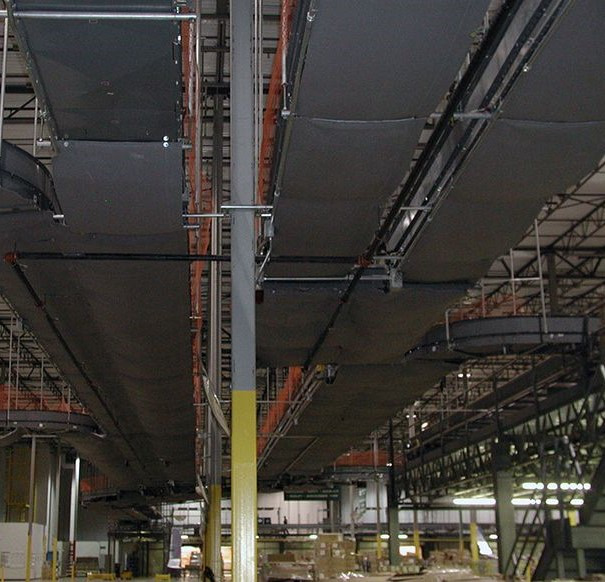
Product Overview
Mass Loaded Vinyl (MLV) is a dense, flexible sound barrier material designed to block the transmission of sound through walls, ceilings, and floors. Unlike sound absorption materials that reduce echo and reverberation, MLV is specifically engineered to prevent sound from passing through structures.
The material's high density and flexible properties make it an ideal solution for retrofitting existing constructions or incorporating into new builds where space is limited but sound isolation is critical.
Sound Blocking
High STC ratings for superior sound transmission prevention
Easy Installation
Flexible material that conforms to any surface shape
Versatile Application
Suitable for walls, floors, ceilings, and mechanical equipment
Applications
Technical Specifications
| Base Material | Virgin PVC polymer (70%) + barium sulfate filler (30%), lead-free formula |
| Available Thickness | 1mm±0.1 (1 lb/ft²), 2mm±0.1 (2 lb/ft²), 3.2mm±0.2 (½ lb/ft²) |
| Roll Dimensions | 1220mm×10m, 1220mm×15m, 1220mm×30.5m (width tolerance ±5mm) |
| Surface Density | 2.44kg/m² (1mm), 4.88kg/m² (2mm), 7.81kg/m² (3.2mm) |
| STC Performance | STC 27 (1mm), STC 30 (2mm), STC 33 (3.2mm) - ASTM E90 tested |
| Operating Temperature | -40°C to +82°C continuous, -50°C to +100°C intermittent |
| Fire Performance | Class A ASTM E84 (FSI ≤25, SDI ≤450), self-extinguishing |
| Physical Properties | Tensile strength: 1380 N/50mm, Elongation: 220%, Shore A hardness: 85 |
| Fastening Methods | Crown staples (10mm), roofing nails, construction adhesive, mechanical clips |
| UV Resistance | 500+ hours QUV-B (ASTM G154), suitable for covered outdoor use |
| Chemical Resistance | Resistant to oils, mild acids, alkalis, moisture (water vapor: <0.1g/m²/24h) |
Installation Methods
Wall Installation
- • Install between wall studs
- • Overlap seams by 2 inches
- • Seal edges with acoustic caulk
- • Cover with drywall or finishing material
Ceiling Installation
- • Attach directly to ceiling joists
- • Use temporary support during installation
- • Ensure proper overlap at seams
- • Install resilient channels if required
Floor Installation
- • Lay over subfloor before finished flooring
- • Roll out perpendicular to floor joists
- • Tape seams with acoustic tape
- • Trim around obstacles carefully
Equipment Wrapping
- • Wrap around pipes and ducts
- • Secure with mechanical fasteners
- • Leave access for maintenance
- • Use appropriate thickness for application
Performance Characteristics
Sound Transmission Loss
Blocks airborne sound transmission across wide frequency range
Mass Law Principle
Higher mass density provides better sound blocking performance
Frequency Response
Effective across human hearing range (20 Hz - 20 kHz)
Impact Sound
Reduces impact noise transmission when used as underlayment
Key Benefits
Space Efficient
Minimal thickness required compared to traditional mass barriers
Versatile
Adapts to irregular surfaces and tight spaces
Cost-Effective
More affordable than rebuilding walls for sound control
Durable
Long-lasting performance with minimal maintenance required
Safe
Lead-free formulation with low VOC emissions